
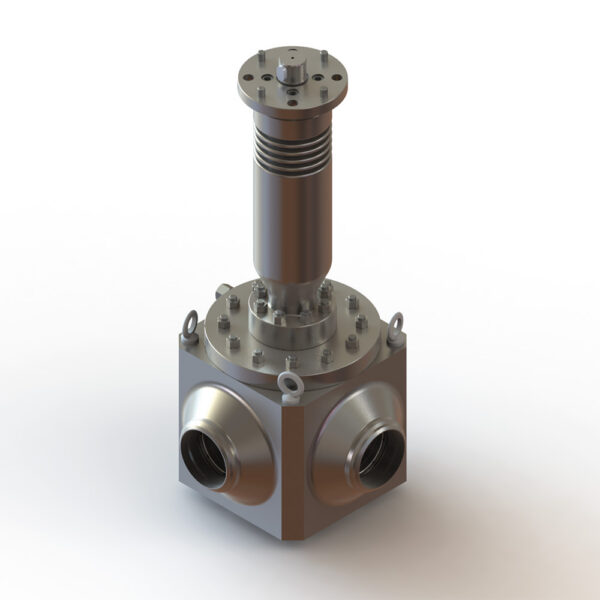

Cryogenic
Pressure Classes: ANSI 150-2500
Sizes: 1/2’’ to 52’’
- Side entry and top entry
- Two or three pieces body construcion
- Bolted Joints
- Flanged, Socket Weld, Butt Weld, NPT Thread
- Extremely wide selection of materials for both body and internals, including: carbon steel, low alloy steels, stainless steels, Duplex
- Overlays
- Coatings: Tungsten Carbide, Chromium Carbide and ENP
- Soft or Metal Seated
- Double Block & Bleed
- Overlay on Sealing Surfaces
- Cladding in Seat Pocket Areas
- Fully Internally Cladded
- Special constructions available for High and Low Temperature (Cryogenic)
- Cryogenic type-test, Fugitive emissions type-test and Fire Safe type-test certificates

- Description
Description
A cryogenic valve is a specialized valve designed to operate in extremely low-temperature environments, typically below -40°C. They are essential for handling and controlling the flow of liquefied gases like liquid oxygen, nitrogen, hydrogen, and helium. Standard valves cannot be used for these applications because their materials can become brittle and their seals can fail due to thermal contraction at such low temperatures, leading to dangerous leaks. Cryogenic valves are constructed with specific materials, such as austenitic stainless steel, and feature a special design, often with an extended bonnet or stem, to keep the valve’s packing and seals at a temperature above the freezing point of the fluid, preventing them from becoming ineffective.
Types of Cryogenic Valves
There are several types of cryogenic valves, each suited for different applications and flow control needs:
- Cryogenic ball valves: These use a ball with a hole to control flow. They offer excellent flow characteristics and a tight seal, making them ideal for on/off applications where an unrestricted flow path is required.
- Cryogenic globe valves: Characterized by their spherical shape, these valves use a movable disc to regulate flow. They are excellent for throttling or precise flow control, but are not recommended for high-flow systems due to increased pressure drop.
- Cryogenic Gate Valves: These valves use a wedge-shaped gate that moves perpendicular to the flow. When fully open, they offer minimal pressure drop, making them suitable for isolation applications where the valve is either fully open or fully closed.
- Cryogenic Butterfly Valves: These are lightweight and economical, using a rotating disc to control flow. They are ideal for applications that require quick opening and closing actions.
- Cryogenic Check Valves: Designed to prevent backflow, these valves ensure that the cryogenic fluid flows in only one direction, which is critical for system safety.
- Cryogenic Relief Valves: These safety valves are designed to protect the system from over-pressurization by automatically venting excess pressure when it exceeds a set limit.


