

Flanges

Specifications
- Size Range: 1/4″ to 72”
- Rating and Wall thickness: Class 150 to 2500, SCH 10 to SCH XXS, API 3000-15000
- Material: Carbon Steel, Stainless Steel, Alloy Steel, Exotic alloys
- Type: Slip-on, Weld Neck, Socket Weld, Threaded, Blind and Lap Joint
- Applicable Standard: ASTM, ANSI, API

- Description
Description
A flange is a forged or cast ring that is attached to a pipe, valve, or other equipment to form a joint. It provides a way to connect two components, allowing for easy assembly, disassembly, and maintenance of a piping system. A flange joint is made by bolting together two flanges with a gasket in between, creating a secure and leak-tight seal.
Types of Flanges
Flanges come in various types, each de signed for specific applications based on pressure, temperature, and service requirements.
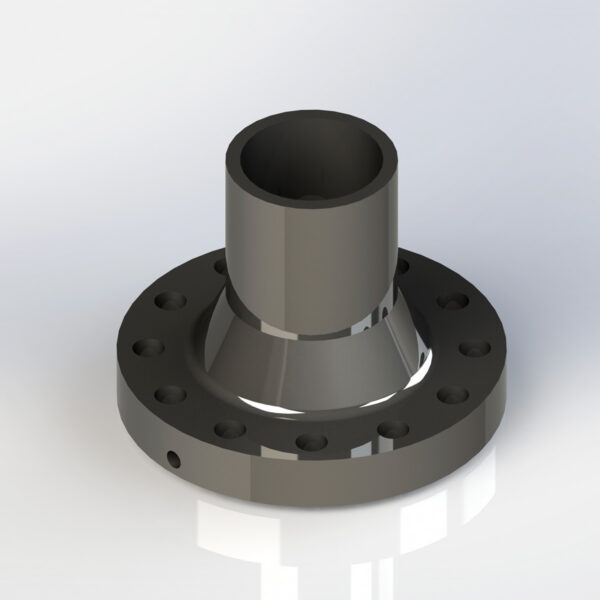
- Weld Neck Flange: Features a long, tapered hub that is butt-welded to the pipe, providing a strong, leak-tight joint for high-pressure and high-temperature applications.
- Slip-On Flange: Slips over the pipe and is welded to it from both the inside and outside. It is easy to align but has a lower pressure rating than a weld neck flange
- Blind Flange: A solid disc used to seal off the end of a piping system or a vessel opening. It provides a means for future expansion or maintenance access.
- Socket Weld Flange: Has a recessed shoulder that the pipe is inserted into before being fillet welded. This design is common for small-diameter, high-pressure piping.
- Threaded Flange: Features internal threads and is screwed onto a pipe without welding, making it suitable for low-pressure, non-critical applications where welding is not feasible.
- Lap Joint Flange: Used with a stub end that is butt-welded to the pipe. This allows the flange to freely rotate, which simplifies bolt alignment during installation.
ASME and API Standards
The design, manufacturing, and testing of flanges are governed by strict industry standards to ensure safety and interchangeability.
- ASME B16.5: This is the most common standard for flanges, covering steel pipe flanges and flanged fittings from NPS 1/2 through NPS 24. It specifies pressure-temperature ratings, materials, dimensions, and testing requirements.
- ASME B16.47: This standard covers flanges for larger pipe sizes, specifically from NPS 26 through NPS 60. It is further divided into Series A and Series B, which have different dimensions and are not interchangeable
- API 6A: This specification is for wellhead and Christmas tree equipment in the oil and gas industry.. It includes stringent requirements for high-pressure flanges used in upstream applications. It includes stringent requirements for high-pressure flanges used in upstream applications. It also defines two types of flanges: API Type 6B and API Type 6BX, with 6BX flanges having a higher pressure rating.


