
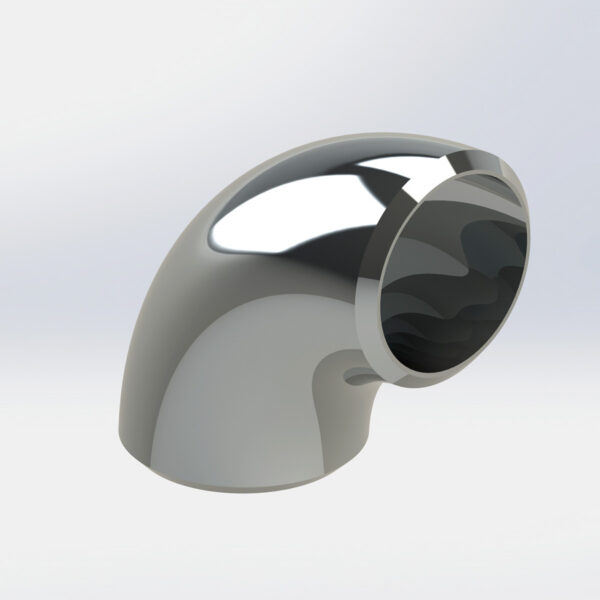

Elbow
Specifications
Butt weld Fittings
- All commonly used Butt weld fittings to ANSI B16.9 & B16.28 MS SP
- Size Range: 1/2″ to 56”
- Wall Thickness: SCH 10 to SCH XXS
- Material: Carbon Steel, Stainless Steel, Alloys Steel, Duplex, Super duplex, Cupronickel
- Applicable Standard: ASME, API 5L, MSS SP-97
Forged Fittings
- Size Range: 1/4” to 4”
- Rati g: 2000, 3000, 6000 and 9000
- Material: ASTM A105N/A 182 F304/L & 316/L, A350 LF2, Monel, Inconel
- Ends: NPT Screwed GAS SCREWED & Socket Weld
- Applicable Standard: ANSI, API, ASTM

- Description
Description
Pipe fittings are components that connect or change the direction of pipes, or provide a means of branching, reducing, or sealing a pipeline. They are crucial for creating complex piping systems.
Types of Fittings
- Elbow: An elbow is used to change the direction of flow. They come in various angles, with 90-degree and 45-degree elbows being the most common. Elbows are also classified by their radius as long radius or short radius.
- Tee: A tee is a T-shaped fitting with one inlet and two outlets, allowing fluid to branch off from a main line. They can be equal tees, where all three ports are the same size, or reducing tees, where one or both outlets are smaller than the inlet.
- Cross: A cross is a four-way fitting with one inlet and three outlets, all at 90-degree angles to each other. They are used to create a four-way junction but are less common than tees due to the high stress they can create at the central point, especially with temperature changes.
- Branch/Olet: An olets (short for outlet) is a type of branch fitting used to create a branch connection from a larger, or “run,” pipe. Unlike tees, which are a full fitting, an olet is a self-reinforced, forged fitting that is welded onto the side of a pipe, saving space and reducing stress concentrations. The most common types are Weldolets, Sockolets, and Thredolets, distinguished by their end connections. Other types like Latrolets (for 45-degree branches) and Elbolets (for branches on elbows) also exist.
ASME and API Standards
The design, materials, and testing of fittings are governed by several key standards to ensure safety, reliability, and interchangeability.
- ASME B16.9: This is a primary standard for wrought butt-welding fittings like elbows, tees, and crosses. It covers dimensions, tolerances, ratings, and testing.
- ASME B16.11: This standard specifies dimensions, ratings, and material requirements for forged fittings like sockolets and thredolets, which are used in smaller-diameter, high-pressure applications.
- MSS SP-97: This is a key standard from the Manufacturers Standardization Society that specifically covers olets fittings. It provides detailed design, material, and testing requirements for integrally reinforced forged branch outlet fittings.
- API 5L: While primarily a standard for line pipes, API 5L can also be referenced for the material and welding requirements of fittings used in critical pipeline applications, ensuring compatibility and structural integrity with the pipes they connect.


